Yulian Zaiats in an Artistic Interior
unknown


Basic information
- ID
- ФотоЛКГ_Zaiats_2
- Author
- unknown
- Name
- Yulian Zaiats in an Artistic Interior
- Date of creation
- 1920s
- Technique
- photograph (printed on paper)
- Place
- Second Polish Republic
Additionally
- Genre
- self-portrait
- Provenance
- Photographic archive of the Lviv Picture Gallery
Information about author
Object description
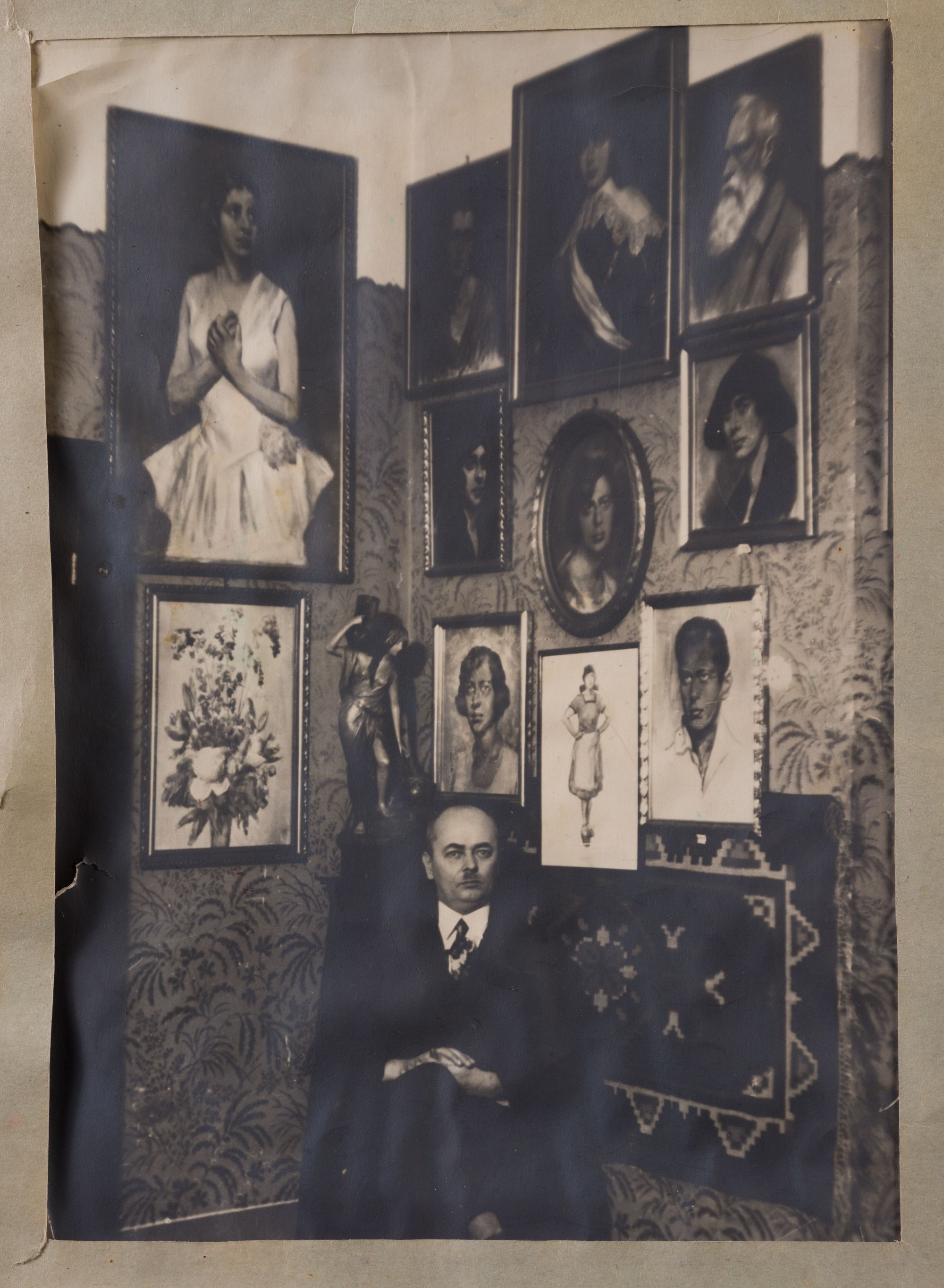
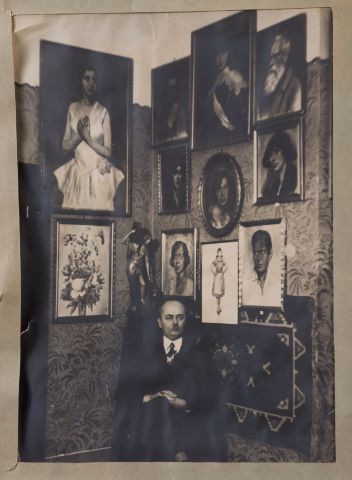
The achromatic photographic print documents a private space – presumably the study or living room of Yulian Zaiats himself, an Ukrainian artist, lawyer, bibliographer, and cultural figure. The photograph serves as an example of the artist's self-presentation through the organization of domestic space, a practice characteristic of the interwar intelligentsia who transformed the walls of their homes into a kind of private gallery.
In the lower part of the frame, a middle-aged man in a dark suit and tie sits in a static pose on an armchair, set against a carpet with a stylized geometric pattern and wallpaper with floral motifs. His gaze is directed straight into the lens, with his hands folded on his lap. This figure is most likely Yulian Zaiats himself, captured at a moment when he appears not as a lawyer or bibliographer, but as a creator of artistic objects within the photograph. Indeed, the wall behind and above the figure is densely filled, in a manner typical of salon-style hanging, with framed paintings of various formats and sizes: portraits, bust-length images, an oval medallion with a woman's face in the center of the composition, and a floral still life in the lower left corner. Some of the frames are tilted at an angle to the wall – a technique that allowed for a denser display within a limited area while simultaneously preventing glare during photography.
Among the portraits, the image of a bearded man in the upper right corner stands out. This may be a representative portrait of someone from an older generation of the family or the cultural milieu to which the collection's owner belonged. However, it is also plausible that it could be a copy of a work by another artist, as Yulian Zaiats actively engaged in such practice. Next to the frames, a ceramic (presumably) sculptural figurine is positioned on a small console – a detail that underscores the status of the room as a space of aesthetic reflection, rather than one of a domestic or purely representative order.
Compositionally, the photographer deliberately selects a low-angle shot looking upwards, which allows for the inclusion of the maximum number of artworks on the wall, subordinating the human figure to the mass of images above it. The individual here functions as part of the ensemble, a curator and simultaneously an exhibit of his own collection, rather than the dominant center of the frame.
It is worth emphasising that congruent documentary photographs of the interiors of private collections constitute a distinct and exceptionally valuable category of sources for researchers of the history of the Lviv artistic milieu of the interwar period in Galicia. They record not only specific works (some of which may currently be lost or dispersed among various institutions) but also the general culture of collecting of that era. Consequently, the photograph serves as an important visual testimony to the existence of Yulian Zaiats's art collection prior to its dispersal among several museum institutions – including Andrey Sheptytsky National Museum in Lviv, Vasyl Stefanyk National Scientific Library of Ukraine, and the Gallery's archive – and allows for the reconstruction, at least partially, of the space in which the artist lived and worked.
Legal regulation
Borys Voznytskyi Lviv National Art Gallery