Family Photo of Yulian Zaiats
unknown
Basic information
- ID
- ФотоЛКГ_Zaiats_1
- Author
- unknown
- Name
- Family Photo of Yulian Zaiats
- Technique
- photograph (printed on paper)
- Place
- Austro-Hungarian Empire
Additionally
- Genre
- group portrait
- Provenance
- Photographic archive of the Lviv Picture Gallery
Information about author
Object description
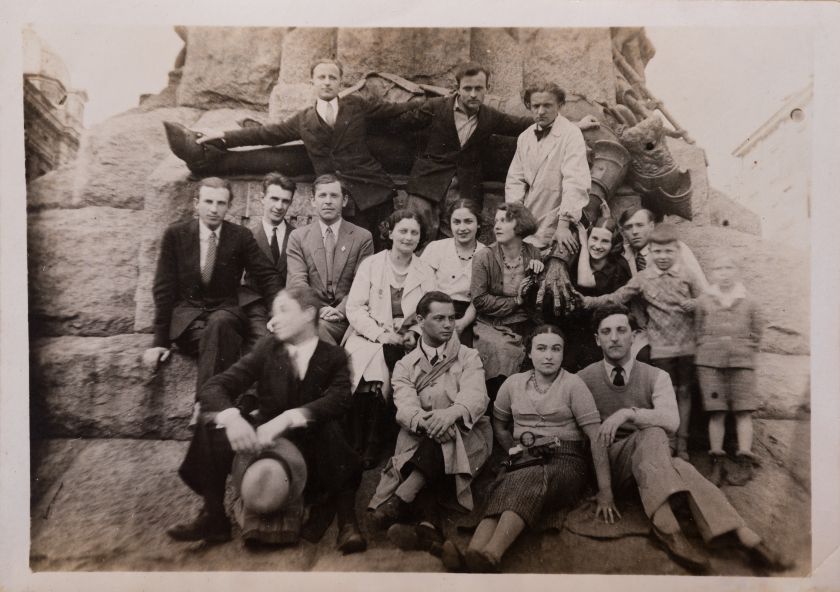
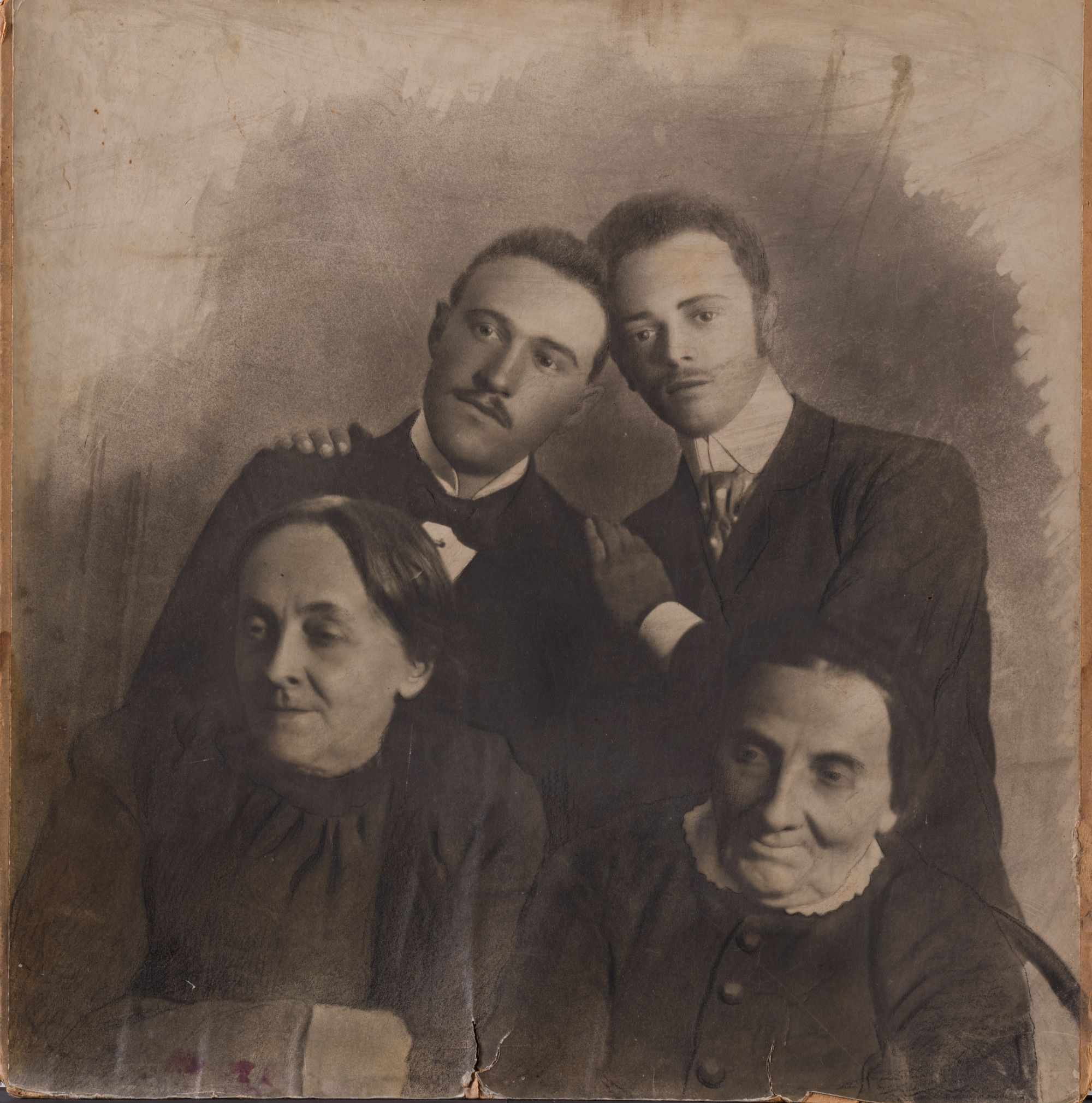
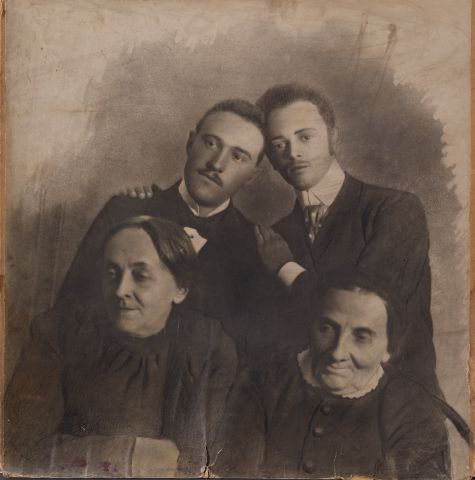
The photographic print belongs to the same personal archival fund as the interior photograph ФотоЛКГ_Zaiats_2. It documents an event not as a private space of a collection, but as a classic studio family portrait executed in accordance with the photographic convention of the turn of the twentieth century. It features a so-called "painted backdrop", with the figures arranged in a distinctive pyramid formation, where the figures at the back are standing and those in the foreground are seated.
Two young people are positioned in the upper tier of the composition. On the left is a dark-haired, moustached man wearing a dark suit with a white bow-tie collar, whose right hand rests on the shoulder of the woman seated in front of him – a gesture denoting kinship proximity and, likely, family status in relation to her. On the right stands another young man, also moustached, in a dark suit with a wide tie. His calm, somewhat detached facial expression, posture, and gaze directed straight into the lens are typical of the formal representative photography of that era. Both men stand close to each other, their figures forming a solid dark mass against which the light faces and collars appear particularly distinct.
The lower tier depicts two elderly women. Both are dressed in dark, high-necked attire, which was characteristic of bourgeois or intellectual domestic life at the turn of the century. On the left is a woman with smoothly combed hair and a calm, contemplative facial expression; on the right is another woman, who displays a subtle smile. This asymmetry of expressions – contemplation on the left and a slight smile on the right – imparts a certain lively, individualised note to the otherwise formal genre, which is uncharacteristic of purely ceremonial family photographs of this period.
Compositionally, the photographer structures the frame on the principle of a strict pyramid: the two seated figures form a wide, stable base, the two vertical figures behind create a narrowed apex, and the gesture of the hand on the shoulder connects both tiers into a single, visually and emotionally linked group. This type of composition is a typical example of a studio family portrait from the late nineteenth to the early twentieth century, common among the bourgeois and intellectual circles of Galicia, to which the Zaiats family belonged.
Given the cut of the clothes, the style of the hair, and the general aesthetics of the photograph (a retouched print on a mount with a tonal background transition characteristic of the studios of that time), the image can be dated to approximately 1900–1910. This period predates or coincides with the early years of the artist's education. Assuming that the photograph depicts members of his family (possibly Yulian Zaiats himself in his youth alongside a brother or relative, as well as his mother and another older female relative), the photograph acquires significance as an important biographical source. It stands as one of the few visual testimonies of the family environment in which the persona of the artist – characterised by a consistent artistic and collecting practice – was formed.
Such studio portraits, preserved in the personal archives of cultural figures, constitute valuable iconographic material for reconstructing the familial and social context in which the generation of the Galician intelligentsia of the late nineteenth and the first third of the twentieth century was formed, which is vital for the study of the artistic life of the region.
Legal regulation
Borys Voznytskyi Lviv National Art Gallery