Back

Spring 1813

Wojciech Kossak
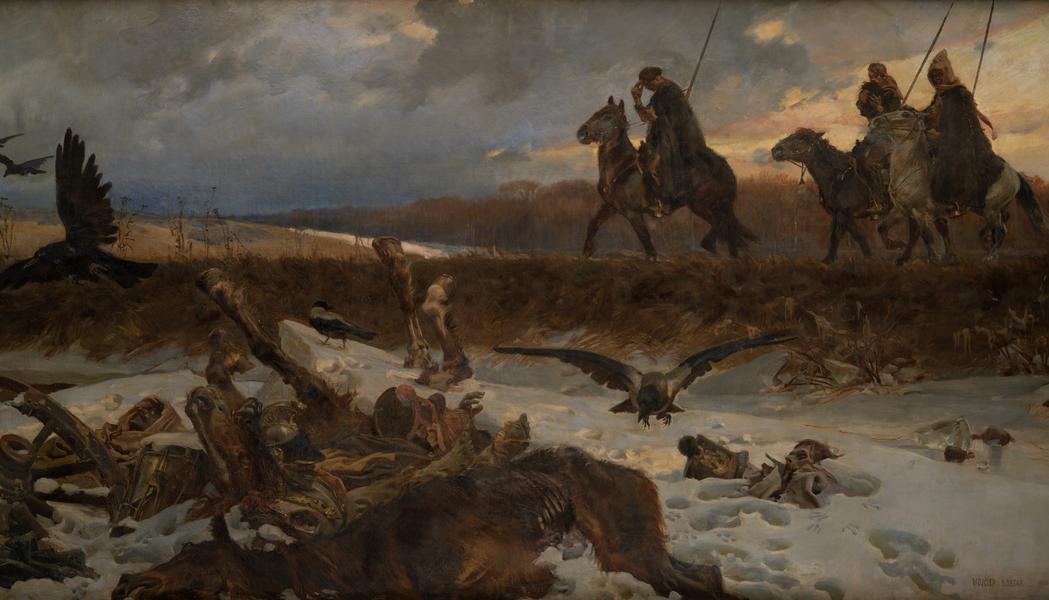
  • Spring 1813
Basic information
ID
Ж-928
Author
Wojciech Kossak
Name
Spring 1813
Date of creation
1904
Technique
oil painting
Material
canvas oil
Dimensions
148 x 272 cm (height x width)
Additionally
Information about author
Author
Wojciech Kossak
Author in the original
Wojciech Kossak
Artist's lifetime
1856–1942
Biography
Wojciech Kossak (31 December 1856, Paris – 29 July 1942, Kraków) – prominent Polish battle painter and graphic artist. Son of famous painter Juliusz Kossak, from whom he received his first drawing lessons. He studied at Kraków Academy of Fine Arts under Władysław Łuszczkiewicz (1871–1873). Later, he continued his studies in Munich, where the work of Józef Brandt exerted a significant influence on the young artist. After military service in 1876–1877, Kossak went to Paris, where he refined his mastery at the National School of Fine Arts (École des Beaux-Arts).
In 1884, the artist settled in Kraków. During 1893–1894, he stayed in Lviv, where he worked on the large-scale "Racławice Panorama" alongside Jan Styka and other artists. Kossak was responsible for creating most of the dynamic battle scenes. Possessing a profound knowledge of military history and being an outstanding master of equine depiction, he detailed the cavalry clashes with meticulous precision. The artist reproduced the uniforms, equipment and weapons of both armies with documentary accuracy.
After the panorama was exhibited in Lviv, the artist left for Berlin, where, together with other masters, he created the panorama "Napoleon's Crossing of the Berezina", which gained considerable popularity. With the outbreak of the First World War, he served in the Austrian army. Despite his military duties, in 1915 he was appointed professor of battle painting at the Warsaw School of Fine Arts, where he taught until 1919. After the war, he returned to Kraków, and during the interwar period, he visited the USA several times. With the beginning of the Second World War, Kossak remained in German-occupied Kraków. There, he took office as president of the Society of Friends of Fine Arts, hoping to negotiate with the occupying authorities for the protection of Polish cultural heritage.
Wojciech Kossak left a significant mark on the history of Polish art as one of the leading representatives of historical and battle painting. The core feature of his artistic stance, shaped under the influence of his father's art, was patriotism, which manifested itself in series of easel paintings and monumental canvases.
The artist's works are held in the National Museum and the Polish Army Museum in Warsaw, as well as in the National Museum in Kraków. The artist's most famous work, "Racławice Panorama", created jointly with Jan Styka, is on display in Wrocław. Kossak's works are also represented in museums in Katowice, Poznań and Przemyśl. In Ukraine, the artist's works are preserved in Borys Voznytskyi Lviv National Art Gallery and the Kropyvnytskyi Regional Art Museum. Kossak was a commercially successful and prolific artist, which is why hundreds of his works are kept in private collections across European countries.
Object description
On the right-hand side of the work, against the background of a spring landscape, three horsemen are depicted. They ride their horses past a ditch with the dead bodies (in the foreground of the work), where human and animal bodies, military clothing and equipment can be seen from under the melting snow in the sunlight. Crows fly over the dead.
Inscriptions
In the bottom left, there are the author's signature and date of creation (some letters and numbers can not be read): "Wojcieh Kossak_1904"
Legal regulation
Borys Voznytskyi Lviv National Art Gallery
Link copied