Back

A Series of Six Sheets Depicting Decorative Vases with a Bouquet of Flowers. Sheet No.4. A Line of Vases

Stefano della Bella
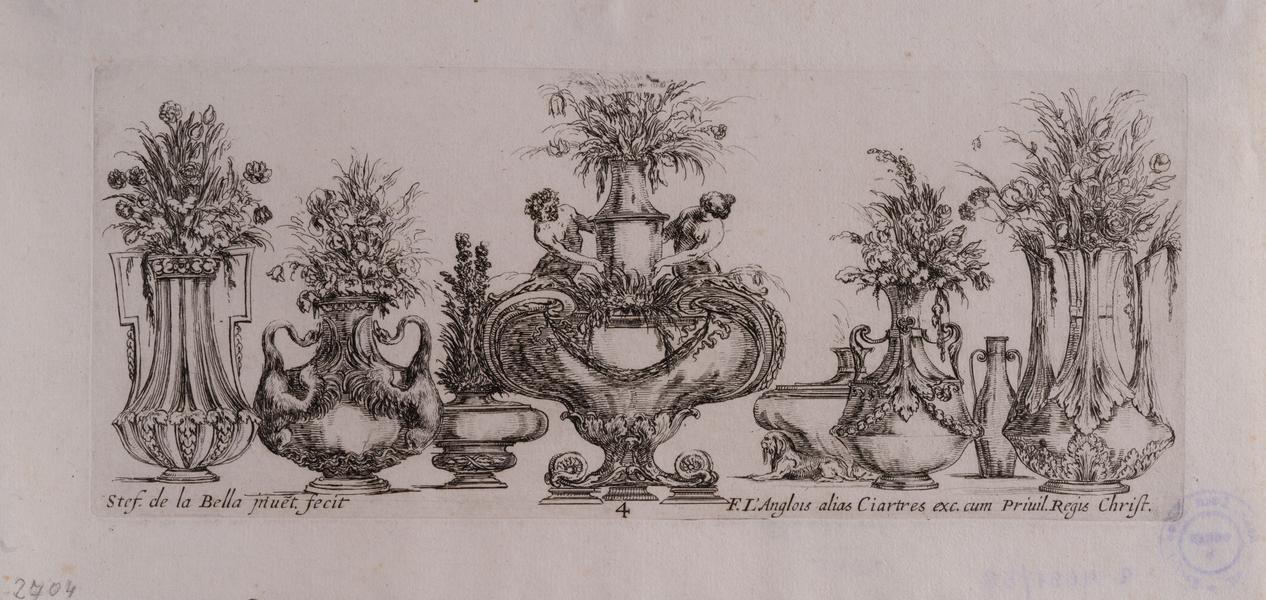
  • A Series of Six Sheets Depicting Decorative Vases with a Bouquet of Flowers. Sheet No.4. A Line of Vases
Basic information
ID
Г-IV-998
Author
Stefano della Bella
Name
A Series of Six Sheets Depicting Decorative Vases with a Bouquet of Flowers. Sheet No.4. A Line of Vases
Date of creation
2d half of the 18th c.
Country
Italy
Technique
etching
Material
paper
Dimensions
8.5 x 19.5 cm (height x width)
Additionally
Type
graphic art
Genre
decorative
Plot
Vase
Provenance
Lviv Historical Museum
Information about author
Author
Stefano della Bella
Author in the original
Stefano della Bella
Artist's lifetime
1610–1644
Country
Italy
Biography
Stefano della Bella (Italian: Stefano della Bella; 1610, Florence – 1664, ibid.). A prominent Italian artist, engraver and etcher of the Early Baroque period, Stefano della Bella was one of the most prolific European printmakers of the 17th century. Following the untimely death of his father, the youth began training in a goldsmith's workshop. Around 1623, he moved to the workshop of the engraver Orazio Vanni, where he mastered the basic techniques of printmaking. Later, he refined his etching technique in the workshop of Remigio Cantagallina – the mentor of the famous French master Jacques Callot. Copying Callot's works significantly influenced the formation of della Bella's own refined artistic style.
During this same period, the artist secured the patronage of the Medici family, who supported him throughout his life. In 1633–1639, funded by his primary patron, Prince Lorenzo de' Medici (uncle of Ferdinand de' Medici, Grand Duke of Tuscany), the artist lived and studied in Rome. There, he immediately received major commissions and made numerous sketches of park ensembles, villas, palaces and ancient ruins, which he later incorporated into his engravings.In Rome, della Bella met the French printmakers Israel Henriet and François Langlois, thanks to whom he moved to Paris in 1639. In France, the artist quickly achieved immense popularity, establishing close and successful collaborations with them, as well as with the leading Parisian publisher Pierre Mariette. His etchings were in high demand among European collectors. In 1650, due to anti-Italian unrest in France (the Fronde), the engraver returned to his native Florence. During this late period, he significantly diversified his favourite themes, creating a series of hunting scenes, landscapes with Roman ruins and detailed depictions of horsemen.
Over his lifetime, Stefano della Bella created more than a thousand unique etchings and thousands of drawings. He worked across battle, landscape, animal, ornamental and genre scenes, capturing the events of his time with documentary precision – from the lavish theatrical pageants of the Florentine nobility to the harsh realities of the Thirty Years' War and the everyday street life of European cities. He became famous for his jewelry-fine, filigree-detailed miniature works.
Object description
Stefano della Bella executed several graphic series with decorative sketches intended for craftsmen. "Raccolta di vasi diversi" ("The Collection of Various Vases"), on which the artist worked from 1639 to 1646, was one of the most popular ones. The series consisted of six sheets with sketches of decorative vases. Della Bella skilfully combined real plant elements with fanciful figures in them. The collection was published in Paris in the printing house of Francois L'Anglois, the publisher and graphic artist with whom della Bella collaborated closely. The series was a great success. It was reprinted several times and significantly impacted decorative and applied art until the end of the 18th century. The work is the fourth sheet of the series. It depicts eight variously shaped decorative vases with flowers. They are adorned with figures, as well as plant and animalistic elements. The central vase, which resembles a stylised hydria in shape, is embellished with satyr figures and nymphs.
Inscriptions
At the bottom left, there is the inscription: "Stef. de la Bella Inuent fecit". The number "4" is at the bottom centre. At the bottom right is the inscription "F. L'Anglois alias Ciartres exc. cum Priuil. Regius Christ".
Legal regulation
Borys Voznytskyi Lviv National Art Gallery
Link copied