Payment
Georges de La Tour
Basic information
- ID
- Ж-779
- Author
- Georges de La Tour
- Name
- Payment
- Date of creation
- 1620 (?)
- Technique
- oil painting
- Material
- canvas oil
- Dimensions
- 99 x 152 cm (height x width)
Additionally
- Type
- painting
- Provenance
- Received from the Lubomirski Museum, 1940. Previously, before 1930 – the Dabski Gallery.
- Exposition
- Potocki Palace
Information about author
Object description
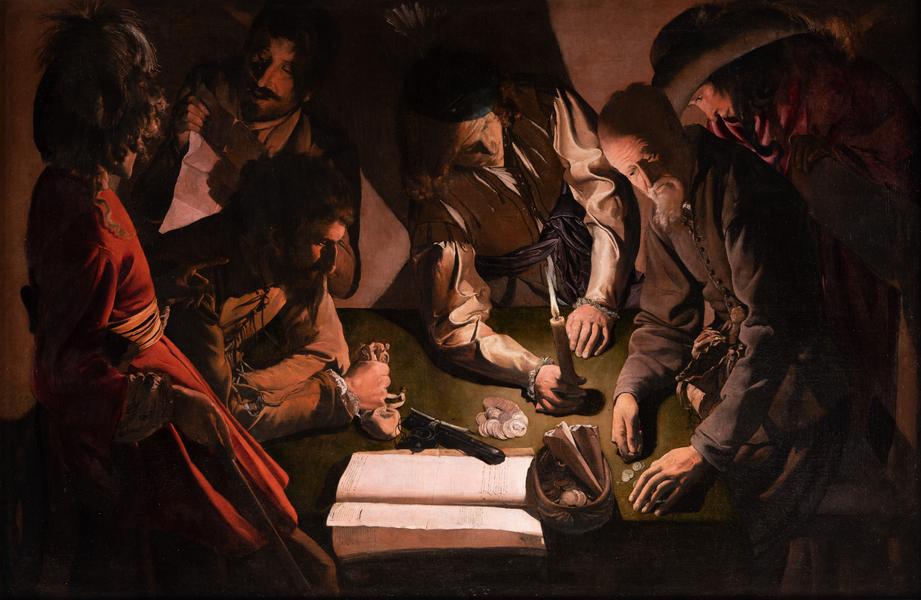
The most renowned painting in the Borys Voznytskyi Lviv National Art Gallery is "Payment" by Georges de La Tour, who worked at the court of Henry II, Duke of Lorraine. The painting's storyline remains mysterious. Jacques Thuillier suggested that the painting was partially cropped, and a figure of Christ should have been on the right. Georges Pariset associated the image with the Calling of Apostle Matthew, which was described in an article by Ulysse Moussalli. Some have also recognised another biblical episode in the painting: "Judas Receiving the Thirty Pieces of Silver". However, the motif of Judas' betrayal is almost absent in the works of Caravaggists. At the beginning of his career, La Tour preferred depicting daylight, and later he started painting nocturnal scenes incorporating interior light – a candle or a lantern – adding more mystery and dramatic effect to his imagery. The candle flame illuminates only certain elements of the composition – faces, hands, and objects on the table. The old man is focused on counting the money, while the man sitting across the table closely observes his actions. Another title of the painting is "The Usurer". It is speculated that the depicted people are peasants paying taxes. In reality, the usurer should exude a certain confidence, while those who come to him would naturally be dependent on him. Here, however, coercion is evident. The old man in grey attire counts the money reluctantly under the watchful gaze of observers, while the young man with a stick points at him as if confirming the points of the document read aloud. This scene most closely resembles an act of extortion from which the population suffered. Similar motifs can be found in the graphic art of Lorraine.
Inscriptions
On the left, near the edge of the canvas (under the elbow of the character in a red long robe), there is a signature: "e De La Tour fec". Underneath the signature is a horizontal line, below it is the date: 16.., which also has a horizontal underline.
Legal regulation
Borys Voznytskyi Lviv National Art Gallery