Back

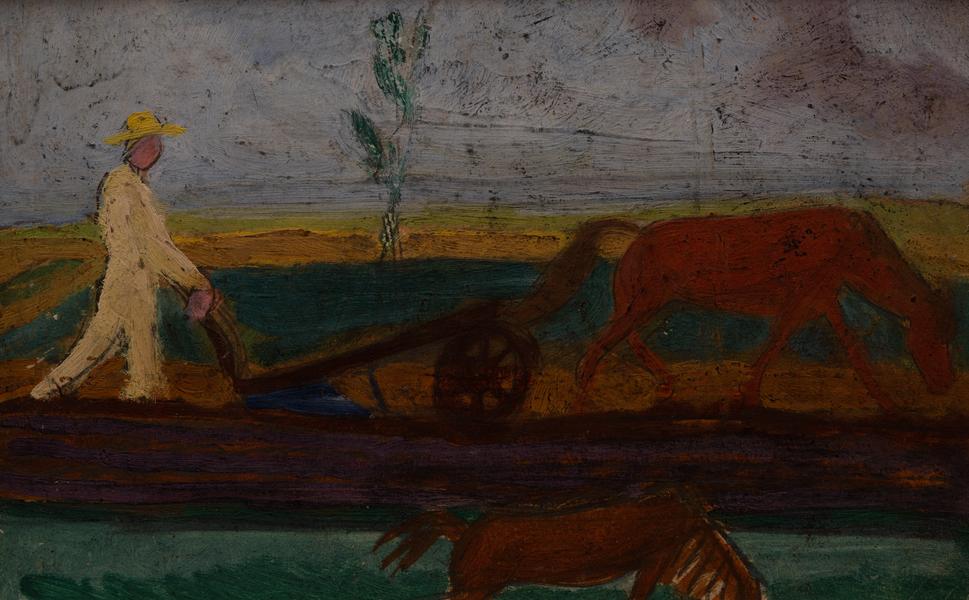
Ploughman (a sketch)

Mykhailo Boichuk
  • Ploughman (a sketch) 1
  • Ploughman (a sketch) 2
  • Ploughman (a sketch) 1
  • Ploughman (a sketch) 2
Basic information
ID
ФМз-Ж-311
Author
Mykhailo Boichuk
Name
Ploughman (a sketch)
Date of creation
1st half of the 20th c.
Country
Ukraine
Technique
oil painting tempera painting
Material
cardboard
Dimensions
16.5 x 26.2 cm (height x width)
Additionally
Information about author
Author
Mykhailo Boichuk
Author in the original
Mykhailo Boichuk
Artist's lifetime
1882–1937
Country
Austro-Hungarian Empire, the USSR, now Ukraine
Biography
Mykhailo Boichuk was a Ukrainian muralist and representative of the Ukrainian cultural Renaissance of the early twentieth century. He was the founder of Boichukism, the original school of Ukrainian art, and leader of the group of Boichukists. His name is given to an artistic phenomenon that combined the forms of folk art and the heritage of Byzantium and Proto-Renaissance. The French called it Renovation Byzantine (Neo-Byzantism). In 1913, he became a member of the Shevchenko Scientific Society, and in 1917 – of the Ukrainian Scientific Society. Mykhailo Boichuk was born on October 30, 1882, in the village of Romanivka, near Terebovlia. He received an excellent artistic education thanks to the support of Metropolitan Andrey Sheptytsky. The painter studied in Lviv, Vienna, Krakow, and later in Munich and Paris. In 1909, he founded his own school where Mykola Kasperovych, Zofia Nalepinska, Zofia Baudouin de Courtenay, Helena Schramm and others studied. In 1911, he returned to Lviv where he worked as a fine art restorer and muralist at the National Museum (now the Andrey Sheptytsky National Museum in Lviv). In 1917, he became one of the founding professors of the Ukrainian State Academy of Arts where he headed the icon and fresco studio. In 1925, Mykhailo was one of the organizers of the Association of Revolutionary Art of Ukraine. The most significant works made together with students were paintings on modern themes in the Lutsk barracks in Kyiv in 1919, Sanatorium for Peasants on the coast of the Khadzhibey Estuary in Odesa between 1927 and 1928, and the Chervonozavodskyi Theater in Kharkiv between 1933 and 1935. All monumental paintings have not survived. On November 25, 1936, Mykhailo Boichuk was arrested and charged with Ukrainian bourgeois nationalism as well as being a leader of a national-fascist terrorist organization. The artist was shot, and most of his works were destroyed.
Object description
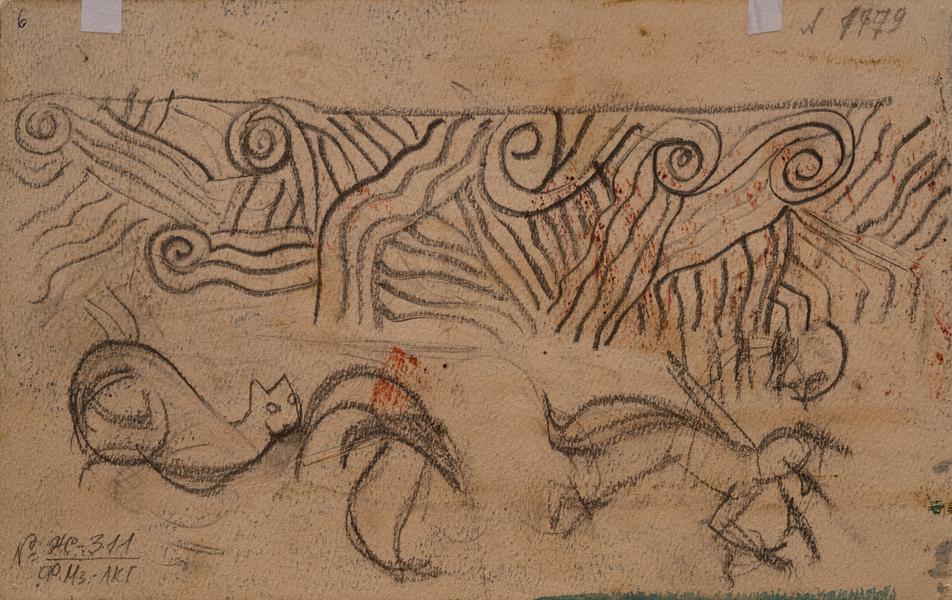
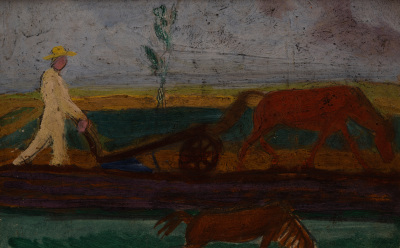
The work is rendered in vibrant and contrasting colours. The ploughman, dressed in white clothes and a yellow hat, follows a plough pulled by a red horse. A purple ploughed strip stretches underneath them. Further in the distance, the painter depicted a pond with dark green water, on the shore of which a tree grows. Mykhailo Boichuk often incorporated plant elements into his other works, appealing to an ancient ornamentalism. A grey sky with subtly greyish-purple clouds stretches over the figures. In the foreground, there is also a sketch of a second horse, depicted from the knees up, pulling something tensely with its head lowered. This horse is painted in dark ochre tones and is set against a green background. On the reverse of the work, there is a pencil sketch of a male figure and an ornament.
Legal regulation
Borys Voznytskyi Lviv National Art Gallery
Link copied