Hermit (Saint Jerome)
unknown (Italian School)
Basic information
- ID
- Ж-1680
- Author
- unknown (Italian School)
- Name
- Hermit (Saint Jerome)
- Date of creation
- 18th c.
- Technique
- oil painting
- Material
- duplicated canvas oil
- Dimensions
- 96.5 x 79 cm (height x width)
Additionally
- Type
- painting
- Genre
- religious
- Plot
- Saint Jerome
- Provenance
- the Lubomirski collection
- Exposition
- Potocki Palace
Information about author
Object description
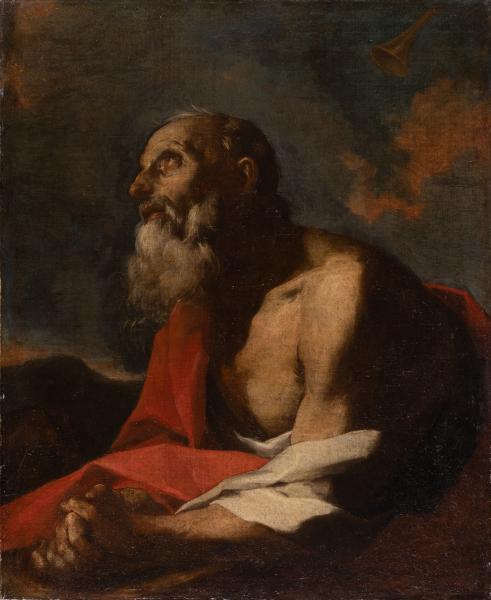
According to one version, the author of the canvas is Giuseppe Antonio Petrini (or his workshop).
Giuseppe Antonio Petrini (1677–1759) was a painter of the Late Baroque period who worked mainly in Lugano (modern-day Switzerland). He is best known for his religious paintings and portraits.
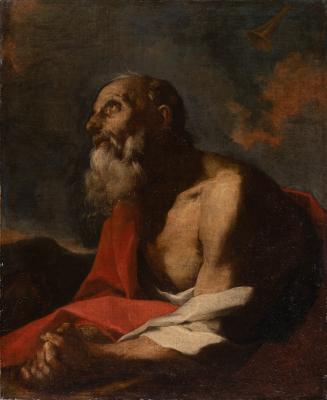
The artwork reproduces the iconographic scene of Saint Jerome the Hermit in the desert during his repentance and listening to the trumpet blast of the Last Judgment.
He is traditionally depicted as an elderly man with a grey beard, wearing a red mantle draped over one shoulder. The hermit's profile stands out distinctively against a backdrop of a heavy, pre-storm sky. His face expresses religious ecstasy, sacred awe, and reverence. His gaze is directed upwards, from where the ascetic hears the voice of the angelic trumpet. His hands are tightly clasped in a tense prayerful gesture.
According to tradition, in order to cleanse his soul and subdue earthly passions, Jerome secluded himself in the desert. There he lived as an anchorite: praying, fasting, and working on the translation of the Bible. One day, the saint suddenly heard the sound of a heavenly horn – a reminder of the transience of earthly life and the inevitability of God's judgment.
The bell of the golden trumpet is depicted in the upper right corner of the painting, amid celestial clouds.
Giuseppe Antonio Petrini (1677–1759) was a painter of the Late Baroque period who worked mainly in Lugano (modern-day Switzerland). He is best known for his religious paintings and portraits.
The artwork reproduces the iconographic scene of Saint Jerome the Hermit in the desert during his repentance and listening to the trumpet blast of the Last Judgment.
He is traditionally depicted as an elderly man with a grey beard, wearing a red mantle draped over one shoulder. The hermit's profile stands out distinctively against a backdrop of a heavy, pre-storm sky. His face expresses religious ecstasy, sacred awe, and reverence. His gaze is directed upwards, from where the ascetic hears the voice of the angelic trumpet. His hands are tightly clasped in a tense prayerful gesture.
According to tradition, in order to cleanse his soul and subdue earthly passions, Jerome secluded himself in the desert. There he lived as an anchorite: praying, fasting, and working on the translation of the Bible. One day, the saint suddenly heard the sound of a heavenly horn – a reminder of the transience of earthly life and the inevitability of God's judgment.
The bell of the golden trumpet is depicted in the upper right corner of the painting, amid celestial clouds.
Portrayed person
- The name of the person portrayed
- Saint Jerome (Jerome of Stridon) – a Christian saint, theologian, writer, and the patron saint of translators. He is renowned for his translation of the Bible from Hebrew into Latin.
- Lifetime of the person portrayed
- 340–420
Legal regulation
Borys Voznytskyi Lviv National Art Gallery