Kmita Rocks in Ojcow
Jan Nepomucen Glowacki

Basic information
- ID
- Ж-1969
- Author
- Jan Nepomucen Glowacki
- Name
- Kmita Rocks in Ojcow
- Technique
- oil painting
- Material
- canvas oil
- Dimensions
- 55.5 x 44 cm (height x width)
Additionally
- Type
- painting
- Genre
- landscape
- Plot
- Landscape
- Provenance
- Collection of Lviv City Gallery
- Exposition
- Potocki Palace
Information about author
Object description
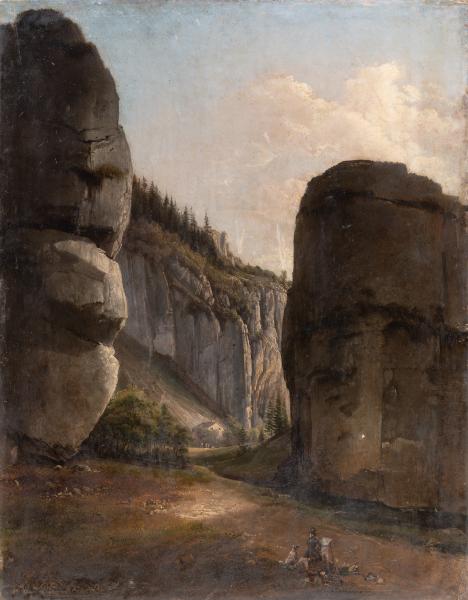
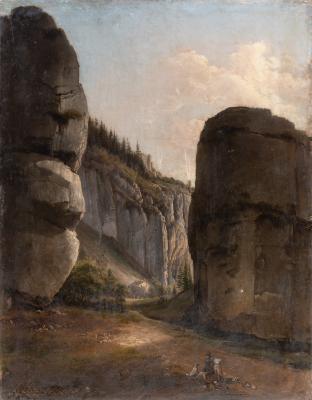
The painting depicts the "Kmita Rocks" landscape nature reserve, located in the Kraków County of the Lesser Poland Voivodeship.
On both sides of a narrow gorge, against a clear sky, rise rocky massifs of grey limestone. The slopes of the rocks are overgrown with dense coniferous forest.
In the right foreground of the painting, the figures of a man with a sketchbox and a dog sitting beside him are depicted. Deep in the gorge, at the foot of the rocks, a small house surrounded by trees is visible, along with the faintly outlined silhouettes of several people. The use of minor staffage allows the artist to emphasise the majesty of the surrounding nature in comparison to man.
The name of the rock derives from the knight Kmita who, according to legend, fell hopelessly in love with the beautiful Olimpia at the beginning of the 16th century – the daughter of Seweryn Boner, the owner of the village of Balice at the time. The girl's father refused to consent to their marriage. Unable to marry his beloved, Kmita, in despair, threw himself off the cliff with his horse into the abyss.
On both sides of a narrow gorge, against a clear sky, rise rocky massifs of grey limestone. The slopes of the rocks are overgrown with dense coniferous forest.
In the right foreground of the painting, the figures of a man with a sketchbox and a dog sitting beside him are depicted. Deep in the gorge, at the foot of the rocks, a small house surrounded by trees is visible, along with the faintly outlined silhouettes of several people. The use of minor staffage allows the artist to emphasise the majesty of the surrounding nature in comparison to man.
The name of the rock derives from the knight Kmita who, according to legend, fell hopelessly in love with the beautiful Olimpia at the beginning of the 16th century – the daughter of Seweryn Boner, the owner of the village of Balice at the time. The girl's father refused to consent to their marriage. Unable to marry his beloved, Kmita, in despair, threw himself off the cliff with his horse into the abyss.
Legal regulation
Borys Voznytskyi Lviv National Art Gallery