Daniel in the Lions' Den
unknown (Flemish School)
Basic information
- ID
- Ж-2000
- Author
- unknown (Flemish School)
- Name
- Daniel in the Lions' Den
- Date of creation
- 17th c.
- Technique
- oil painting
- Material
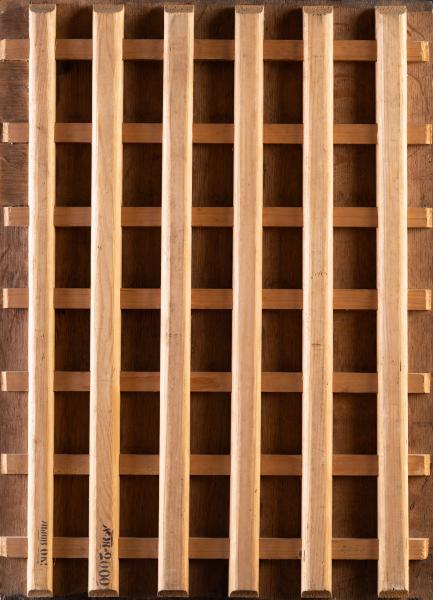
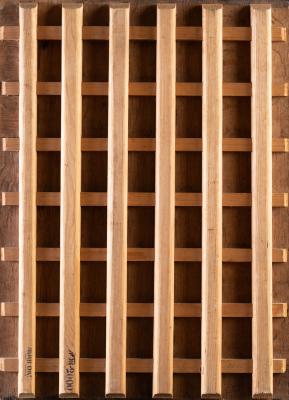
- canvas wood oil
- Dimensions
- 67 x 48.5 cm (height x width)
Additionally
- Type
- painting
- Genre
- religious
- Plot
- Prophet
- Provenance
- Collection of Leon Pininski
- Exposition
- Potocki Palace
Information about author
Object description
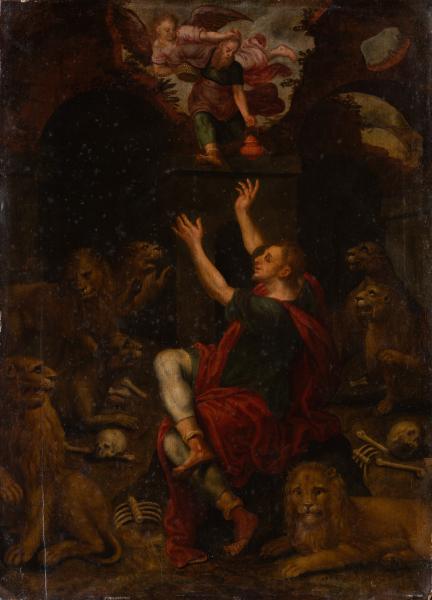
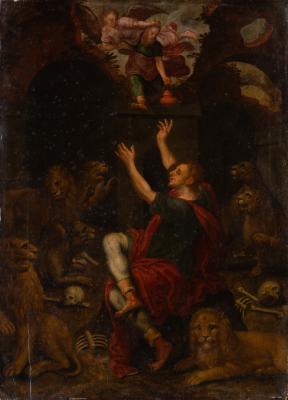
This painting is a fine example of European religious art from the period of Mannerism or early Baroque (late 16th – first half of the 17th century). The canvas depicts a rare biblical subject – Prophet Daniel in the Den of Lions with an Angel Bringing Prophet Habakkuk. This scene is described in the non-canonical part of the Book of Daniel (14:31–39).
According to tradition, Daniel was cast into the lions' den, which in various accounts appears as a cave or an underground dungeon with predators, for refusing to worship pagan idols and Cyrus, the King of Babylon. However, the beasts, tamed by divine power, did not harm the righteous man. When he grew weak from hunger, an angel of the Lord took the Judaean prophet Habakkuk, who was carrying a meal to the reapers, by the hair and instantly transported him, along with the clay pot of food, to Babylon to save Daniel from death.
In this work by an unknown author from the Gallery's collection, the action unfolds in a deep underground dungeon with massive arched vaults. At the centre of the dynamic composition, Prophet Daniel is depicted sitting on a large stone, surrounded by seven lions. Human skulls and bones are scattered across the floor around him. The righteous man is attired in a dark green tunic and a vibrant red cloak, which serves as the primary colour accent of the artwork. The figure of the prophet is rendered in a complex twisting motion (figura serpentinata), characteristic of Mannerism: his head is thrown back, both hands are raised upwards, and his right leg is crossed over the left. Daniel's gaze is directed upwards, where an angel in light-coloured robes appears through an opening in the ruined vault. The celestial messenger holds a bearded man by the hair – the prophet Habakkuk. The latter, depicted in flight, extends a clay pot of food towards the hands of the famished Daniel.
According to tradition, Daniel was cast into the lions' den, which in various accounts appears as a cave or an underground dungeon with predators, for refusing to worship pagan idols and Cyrus, the King of Babylon. However, the beasts, tamed by divine power, did not harm the righteous man. When he grew weak from hunger, an angel of the Lord took the Judaean prophet Habakkuk, who was carrying a meal to the reapers, by the hair and instantly transported him, along with the clay pot of food, to Babylon to save Daniel from death.
In this work by an unknown author from the Gallery's collection, the action unfolds in a deep underground dungeon with massive arched vaults. At the centre of the dynamic composition, Prophet Daniel is depicted sitting on a large stone, surrounded by seven lions. Human skulls and bones are scattered across the floor around him. The righteous man is attired in a dark green tunic and a vibrant red cloak, which serves as the primary colour accent of the artwork. The figure of the prophet is rendered in a complex twisting motion (figura serpentinata), characteristic of Mannerism: his head is thrown back, both hands are raised upwards, and his right leg is crossed over the left. Daniel's gaze is directed upwards, where an angel in light-coloured robes appears through an opening in the ruined vault. The celestial messenger holds a bearded man by the hair – the prophet Habakkuk. The latter, depicted in flight, extends a clay pot of food towards the hands of the famished Daniel.
Legal regulation
Borys Voznytskyi Lviv National Art Gallery