Ecce Homo
unknown
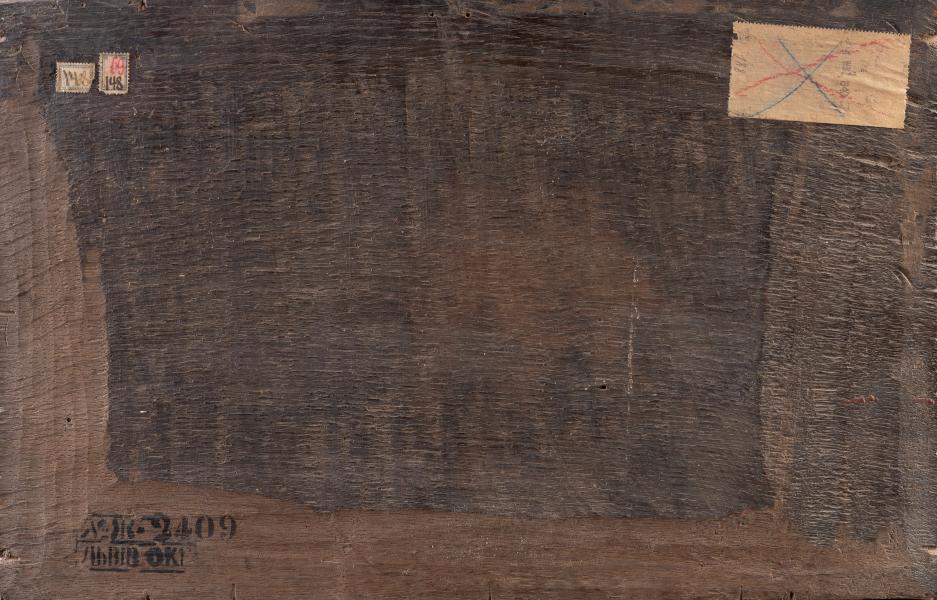
Basic information
- ID
- Ж-2409
- Author
- unknown
- Name
- Ecce Homo
- Date of creation
- 17th–18th c.
- Technique
- oil painting
- Material
- wood oil
- Dimensions
- 29 x 45 cm (height x width)
Additionally
- Type
- painting icon
- Genre
- religious
- Plot
- Ecce homo
- Provenance
- Collection of Lviv City Gallery
- Exposition
- Potocki Palace
Information about author
Object description
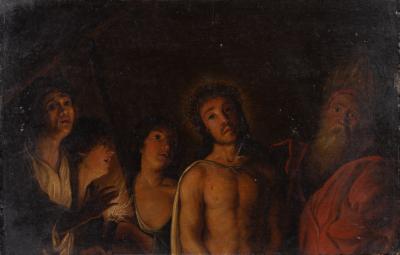
Ecce Homo is the name of an iconographic type of depiction that forms part of the Passion of Christ cycle.
"Behold the man" ("Here is the man" or "This is the man") – these are the words of Pontius Pilate concerning Jesus Christ. According to the Gospel of John, the Procurator of Judea, Pontius Pilate, displayed Jesus Christ to the Jerusalem crowd after his scourging, dressed in a purple robe and crowned with thorns, seeking to evoke the sympathy of the people.
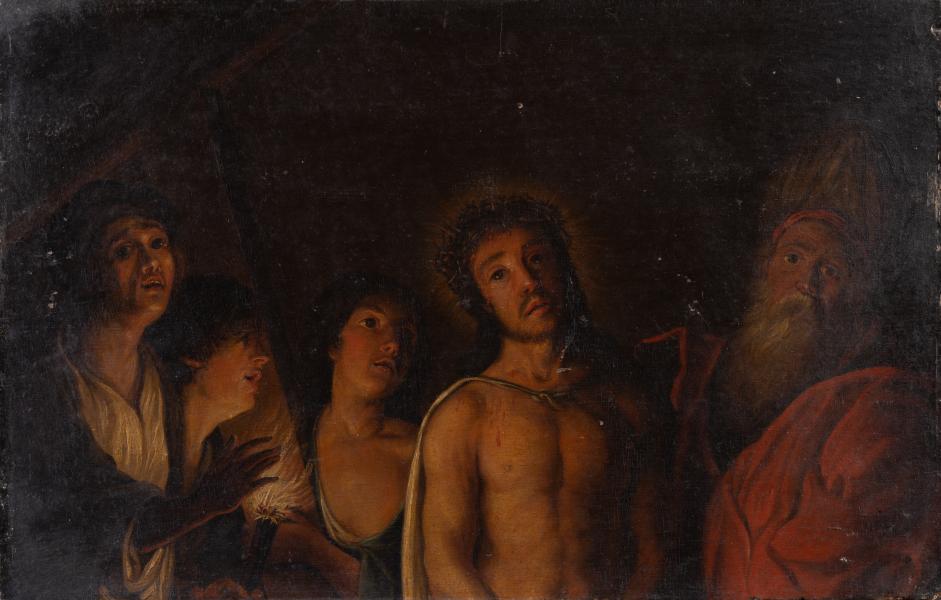
In its stylistic execution, the work from the Gallery's collection belongs to the Baroque era (17th–18th centuries) and demonstrates a profound influence of Caravaggism, where artificial contrast lighting and the deep psychologism of the characters play a pivotal role.
At the centre of a composition of five half-length figures, the figure of the tormented Christ stands out. Upon his head is a crown of thorns, and across his shoulders is a light-coloured cloak, replacing the canonical purple robe.
To the right of Christ is the High Priest Caiaphas – an elderly, grey-bearded man wrapped in a heavy, voluminous cloak of a rich red colour, which creates a colouristic dominance in the right section of the work. His head is crowned with a tall headdress reminiscent of a mitre or an Eastern turban.
To the left are three young people observing the event with trepidation and curiosity. One of them holds a lit torch, which serves as the primary source of light. In the semi-darkness of the background, a large wooden cross – a symbol of the future Golgotha – is visible in the hands of one of the youths.
The unknown artist actively draws the viewer into the space of the painting: the gazes of three out of the five characters – Christ, the High Priest Caiaphas, and the youth with the torch – are directed at the audience, as if with a silent question: "And what will your decision be?"
"Behold the man" ("Here is the man" or "This is the man") – these are the words of Pontius Pilate concerning Jesus Christ. According to the Gospel of John, the Procurator of Judea, Pontius Pilate, displayed Jesus Christ to the Jerusalem crowd after his scourging, dressed in a purple robe and crowned with thorns, seeking to evoke the sympathy of the people.
In its stylistic execution, the work from the Gallery's collection belongs to the Baroque era (17th–18th centuries) and demonstrates a profound influence of Caravaggism, where artificial contrast lighting and the deep psychologism of the characters play a pivotal role.
At the centre of a composition of five half-length figures, the figure of the tormented Christ stands out. Upon his head is a crown of thorns, and across his shoulders is a light-coloured cloak, replacing the canonical purple robe.
To the right of Christ is the High Priest Caiaphas – an elderly, grey-bearded man wrapped in a heavy, voluminous cloak of a rich red colour, which creates a colouristic dominance in the right section of the work. His head is crowned with a tall headdress reminiscent of a mitre or an Eastern turban.
To the left are three young people observing the event with trepidation and curiosity. One of them holds a lit torch, which serves as the primary source of light. In the semi-darkness of the background, a large wooden cross – a symbol of the future Golgotha – is visible in the hands of one of the youths.
The unknown artist actively draws the viewer into the space of the painting: the gazes of three out of the five characters – Christ, the High Priest Caiaphas, and the youth with the torch – are directed at the audience, as if with a silent question: "And what will your decision be?"
Legal regulation
Borys Voznytskyi Lviv National Art Gallery