Back

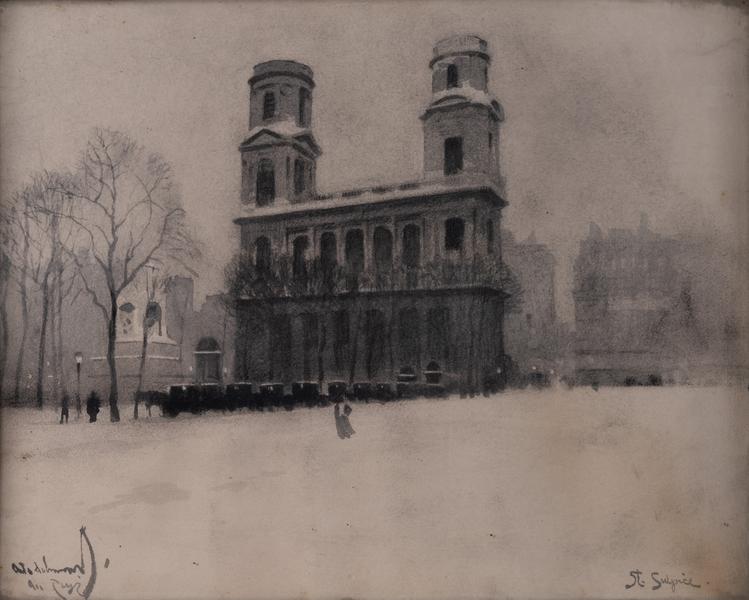
Church of Saint-Sulpice in Paris

Odo Dobrowolski
  • Church of Saint-Sulpice in Paris 1
  • Church of Saint-Sulpice in Paris 2
  • Church of Saint-Sulpice in Paris 1
  • Church of Saint-Sulpice in Paris 2
Basic information
ID
Г-V-29
Author
Odo Dobrowolski
Name
Church of Saint-Sulpice in Paris
Date of creation
1911
Technique
drawing
Material
paper on cardboard coloured pencil Indian ink
Dimensions
26.5 x 33.2 cm (height x width)
Additionally
Type
graphic art
Genre
landscape
Information about author
Author
Odo Dobrowolski
Author in the original
Odo (Otton) Dobrowolski
Artist's lifetime
1883–1917
Country
Austro-Hungarian Empire
Biography
Odo (Otton) Dobrowolski (1883, Chernivtsi – 1917, Kyiv) was a Lviv artist of Polish–German origin, primarily known as a master of graphic art and lithography, as well as an exceptional watercolourist and pastellist.
He was born into the family of Józef Dobrowolski, an official at the Austrian governorship of the Kingdom of Galicia and Lodomeria, and Eugenia Wittich. The artist was likely named after Otto the Great, the first emperor of the Holy Roman Empire. After graduating from a gymnasium in Lviv, in the mid-1900s he studied in Kraków as a non-degree student at the Academy of Fine Arts.
Between 1908 and 1909, thanks to the support of the painter Jan Styka, Dobrowolski lived in Paris, followed by a brief stay in Munich. Upon returning to Lviv, between 1909 and 1910, the artist executed an oil decorative panel for the confectionery of Gabriela Zapolska – a famous playwright, actress, and one of the most prominent figures of the local bohemian elite. In 1911–1912, he worked in Paris once again. Following his return to Lviv, during the Russian occupation of the city during the First World War, he created a highly popular series of ten lithographs.
In June 1915, alongside the retreating Russian forces, the artist departed for Kyiv, where in 1917 the 34-year-old master died under unresolved circumstances.
The creative heritage of Odo Dobrowolski encompasses numerous cityscapes featuring views of Lviv and Paris, alongside portraits, interior sketches, and nature studies. His works are held in Borys Voznytskyi Lviv National Art Gallery, the National Museum in Kraków, the National Library and the Jewish Historical Institute in Warsaw, as well as in private collections.
Object description
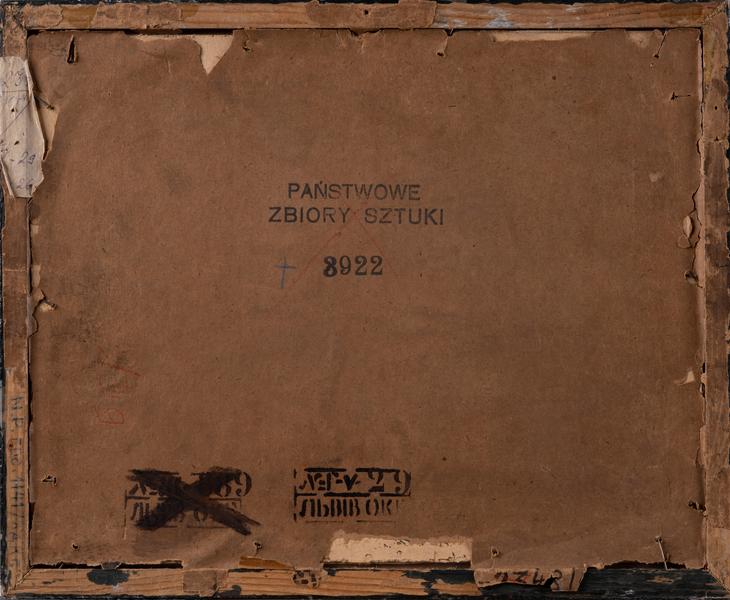
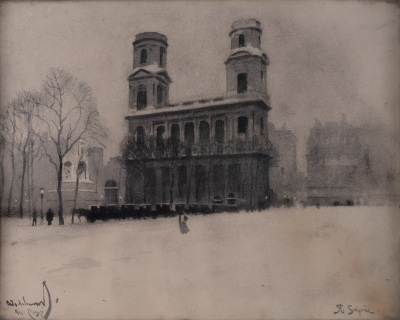
The work was created during the artist’s second stay in Paris (1911–1912). The Parisian church is depicted in winter, reflecting the special place winter vedute (city views) hold in the artist’s oeuvre. At the centre of the composition stands the church with two towers in the Classical style. In front of it, the fountain (Fountain of the Four Bishops) is highlighted as a light patch. Along the façade are lined horse-drawn carriages, suggesting that a young couple is being married inside the church. In the background, the tall buildings of “Haussmannian” Paris are visible. The Church of Saint-Sulpice (Église Saint-Sulpice) is located in the central part of Paris, near the Luxembourg Gardens, and has been known since the 12th century. Its present appearance dates to 1870. Victor Hugo was married in this church.
Inscriptions
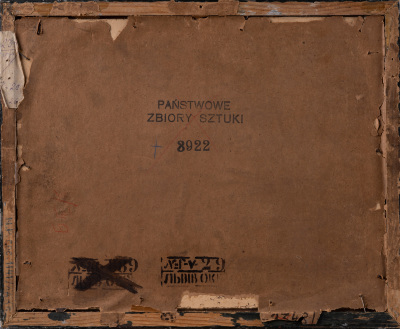
In the lower left corner, there is a place of the creation of the painting and the author's signature “Odo Dobrowolski / 911 Paryż” in italics. On the right – the title of the work “St. Sulpice”. On the back, there is a stamp “Państwowe zbiory sztuki” and stamps of numbers.
Legal regulation
Borys Voznytskyi Lviv National Art Gallery
Link copied