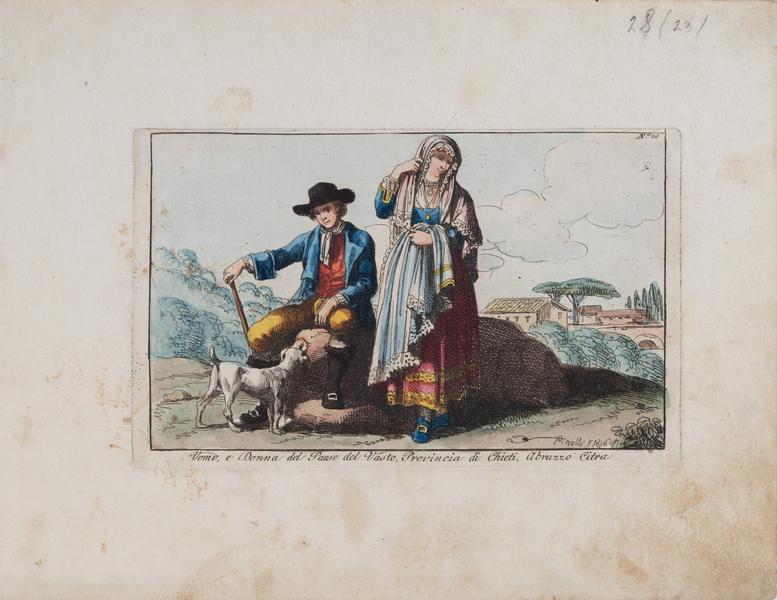
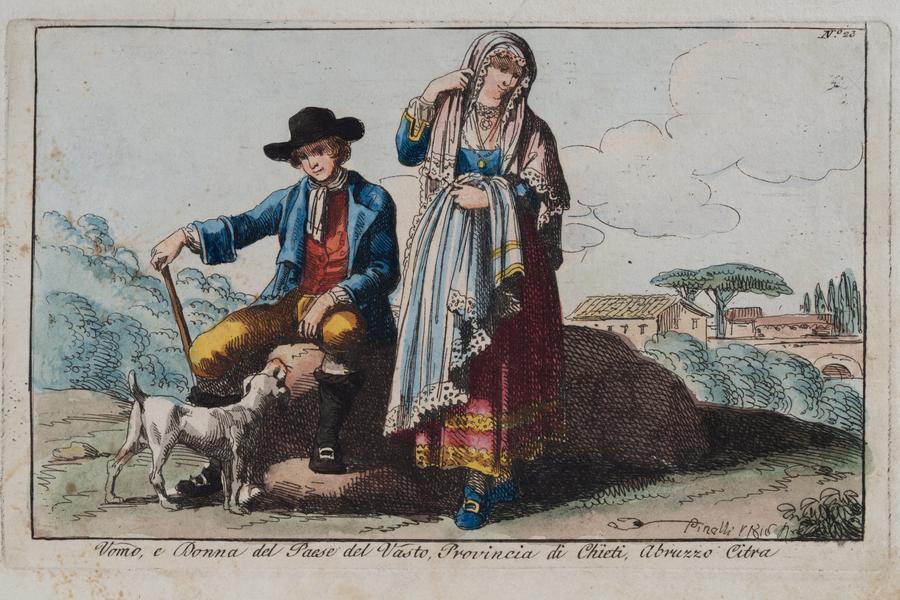
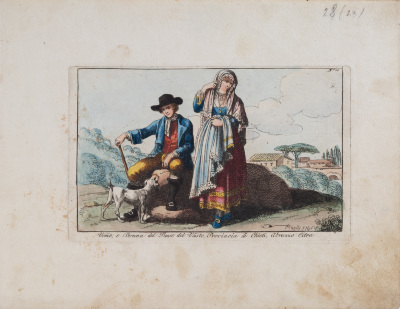
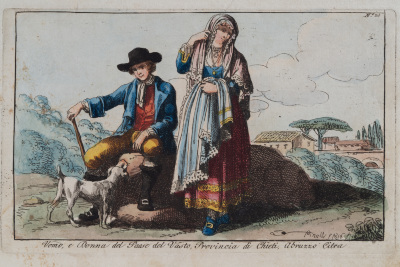
Man and Woman from the Village of Vasto in the Province of Chieti in Lower Abruzzo
Bartolomeo Pinelli
Basic information
- ID
- Г-IV-1724
- Author
- Bartolomeo Pinelli
- Name
- Man and Woman from the Village of Vasto in the Province of Chieti in Lower Abruzzo
- Date of creation
- 1816
- Country
- the USSR russia
- Technique
- etching watercolour
- Material
- paper
- Dimensions
- 10 x 16 cm (height x width)
Additionally
- Type
- graphic art
- Genre
- genre art
- Provenance
- Collection of Faina Tarashchanska (Lviv), 1966
Information about author
Object description
This composition was first introduced in the 1790s in an engraving by Alessandro d'Anna in the album Costumi d'Abruzzo. Pinelli's composition is known in the version of 1816, which was issued in the album Raccolta di Cinquanta Costumi li più interessanti delle città, terre e paesi in provincia diverse del Regno di Napoli (Collection of Fifty Most Interesting Picturesque Costumes from Cities, Towns and Villages of Different Provinces of the Kingdom of Naples) published by Giovanni Scudellari in Rome in 1817. The engraving was also published later. The Lviv engraving of 1828 replicated the composition from the album of 1816 with absolute accuracy, except for the characters' clothing, which was painted differently. The artist took inspiration from the prototype performed between 1783 and 1797. In 1783, King Ferdinand IV of Naples sent in turn four local artists – Alessandro d'Anna, Saverio della Gatta, Antonio Berotti, and Stefano Santucci – to the mountains of his kingdom so that they could paint images of peasants in national festive clothing. At the insistence of Domenico Venuti da Cortona, the director of the Capodimonte factory, those sketches had to be used for decorating the factory's porcelain products. During the Napoleonic invasion and the French conquest of the Kingdom of Naples, those sketches were used by Bartolomeo Pinelli, who repeated them in his art studio in 1809 and 1816 in the albums Raccolta di Cinquanta Costumi Pittoreschi and Nuova Raccolta di Cinquanta Costumi Pittoreschi. In 1816, the Kingdom of Naples was reestablished under the name of the Kingdom of the Two Sicilies. However, at that time, it was not Neapolitans' painted etchings but B. Pinelli's ones used in decorative and applied arts. In Pinelli's work, a girl is shown in the foreground. She approaches a young man sitting on a large boulder, leaning on a stick. At his feet, there is a standing dog. The young man looks amiably at the dog, ignoring a girl dressed in rich national clothes, namely in a headscarf and a cape with openwork lace, a blue waistcoat with cuffs, and a burgundy skirt. She is wearing solid blue shoes on her feet. The young man is dressed in a blue camisole over a red vest, a scarf tied around his neck, and yellow pants. On his feet are knee-high boots, and on his head is a wide-brimmed hat. The characters are painted with bright watercolours, with prevailing yellow, blue, red, and pink colours. The action takes place on a hill, where in the background, the crowns of low trees and a fragment of the ancient city of Vasto, mistakenly classified by the artist as a village (A. d'Anna also called Vasto a village), are depicted.
Inscriptions
In the lower right corner, there is the author's signature in italics – Pinelli, the date – 1816, and the place of performance – Roma (illegibly). In the centre of the engraving, under the image, is the work's title Uomo, e Donna del Paese del Vasto, Provincia di Chieti, Abruzzo Citra. The number "19" is in the upper right corner above the plate.
Legal regulation
Borys Voznytskyi Lviv National Art Gallery