Holy Family
unknown
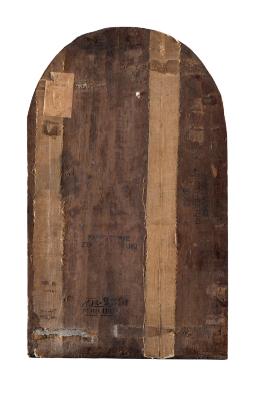
Basic information
- ID
- Ж-2391
- Author
- unknown
- Name
- Holy Family
- Date of creation
- 2d quarter of the 16th c.
- Country
- Netherlands
- Technique
- oil painting
- Material
- wood oil
- Dimensions
- 51 x 31 cm (height x width)
Additionally
- Type
- painting
- Genre
- religious
- Plot
- Nursing Madonna Holy Family
- Provenance
- Collection of Leon Pininski
- Exposition
- Potocki Palace
Information about author
Object description
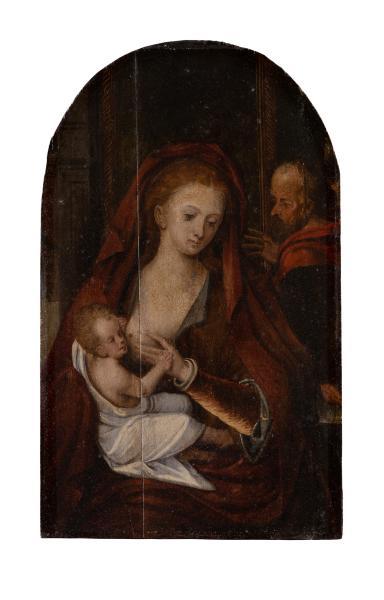
This work, executed on a wooden panel with an arched (rounded) top, is a fine example of Western European religious painting from the Northern Renaissance or 16th-century Mannerism. The unknown artist masterfully employs intimate, soft lighting and subtle chiaroscuro. The subject is based on the iconographic type of the Nursing Madonna with Saint Joseph.
The image of the Virgin Mary breastfeeding the Infant Jesus has been known in sacred art since Early Christian times. The oldest surviving depiction of the Nursing Madonna is preserved in the Catacombs of Priscilla in Rome and dates back to the 2nd century. It is believed that the origins of this iconography can be traced back to ancient Egyptian representations of the goddess Isis nursing her son Horus. The subject was exceptionally popular in both Byzantine and Western European art.
In the composition from the Gallery's collection, the Virgin Mary is depicted almost frontally, with a slight turn to the right. She possesses an appearance characteristic of Northern Mannerism: a high forehead, thin eyebrows, an elongated nose, small lips, and golden-red hair. Her gaze is directed aside and downwards. The Madonna is enveloped in a red-brown veil; with her right hand, she supports her Son, whom she is nursing. The Infant Jesus is reclining, wrapped in a white swaddling cloth.
The figure of Saint Joseph in a red cloak in the right background almost merges with the dark background of the interior, in which architectural elements – presumably doorframes – are faintly visible.
The image of the Virgin Mary breastfeeding the Infant Jesus has been known in sacred art since Early Christian times. The oldest surviving depiction of the Nursing Madonna is preserved in the Catacombs of Priscilla in Rome and dates back to the 2nd century. It is believed that the origins of this iconography can be traced back to ancient Egyptian representations of the goddess Isis nursing her son Horus. The subject was exceptionally popular in both Byzantine and Western European art.
In the composition from the Gallery's collection, the Virgin Mary is depicted almost frontally, with a slight turn to the right. She possesses an appearance characteristic of Northern Mannerism: a high forehead, thin eyebrows, an elongated nose, small lips, and golden-red hair. Her gaze is directed aside and downwards. The Madonna is enveloped in a red-brown veil; with her right hand, she supports her Son, whom she is nursing. The Infant Jesus is reclining, wrapped in a white swaddling cloth.
The figure of Saint Joseph in a red cloak in the right background almost merges with the dark background of the interior, in which architectural elements – presumably doorframes – are faintly visible.
Legal regulation
Borys Voznytskyi Lviv National Art Gallery