Death of a Saint
unknown (Italian School)


Basic information
- ID
- Ж-2494
- Author
- unknown (Italian School)
- Name
- Death of a Saint
- Date of creation
- 18th c.
- Technique
- oil painting
- Material
- copper oil
- Dimensions
- 23.7 x 18.7 cm (height x width)
Additionally
- Type
- icon painting
- Genre
- religious
- Plot
- Saint
- Provenance
- Collection of Lviv City Gallery
- Exposition
- Potocki Palace
Information about author
Object description
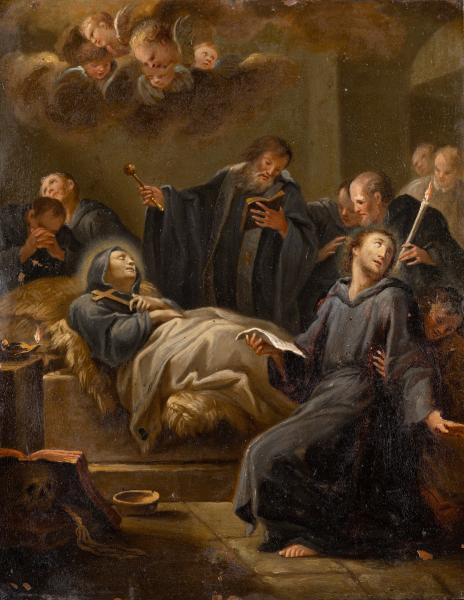
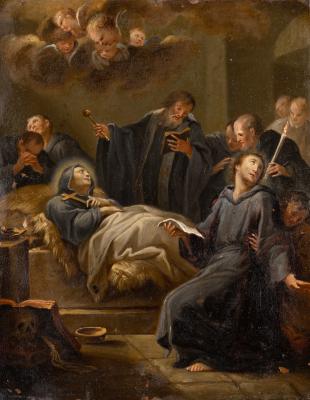
The unknown artist most likely depicted a religious theme that remained highly prevalent for several centuries – the Death of Saint Clare. She was a devoted follower and spiritual companion of Saint Francis of Assisi (13th century), who remains widely revered to this day. Following the example of the Friars Minor, she founded a monastic order for women, later named the Poor Clares in her honour. Renowned for her lifelong miracles, she twice saved Assisi from invading forces by confronting the enemy on the city walls whilst holding the Blessed Sacrament. Consequently, the monstrance is recognised as her traditional attribute. Following her death, the saint's relics remained incorrupt.
The painter has set the scene within a sparse monastic cell, depicting the woman on a deathbed of straw. The figure of Clare occupies nearly the entire left diagonal of the canvas. Haloed with a nimbus, her serene face with closed eyes rests upon her left shoulder. With her arms crossed over her chest, she presses a wooden crucifix close to her heart. Above her, a priest administers the sacrament of extreme unction. Beneath the ceiling, a celestial vortex of cherubim gathers to welcome the saint. The bed is surrounded by friars immersed in prayer or deep contemplation.
The foreground is uniquely dedicated to religious allegory and vanitas symbolism: upon the stone flagstones rests a skull – an emblem of the Fall and, consequently, human mortality. A stack of books represents the limitations and imperfection of human knowledge, providing a base for the open Holy Scripture – the triumph of the Divine Word. Peeking out from beneath the volumes is the end of the knotted cord used by the Franciscans, featuring three distinct knots that symbolise their three vows: chastity, poverty, and obedience.
The painter has set the scene within a sparse monastic cell, depicting the woman on a deathbed of straw. The figure of Clare occupies nearly the entire left diagonal of the canvas. Haloed with a nimbus, her serene face with closed eyes rests upon her left shoulder. With her arms crossed over her chest, she presses a wooden crucifix close to her heart. Above her, a priest administers the sacrament of extreme unction. Beneath the ceiling, a celestial vortex of cherubim gathers to welcome the saint. The bed is surrounded by friars immersed in prayer or deep contemplation.
The foreground is uniquely dedicated to religious allegory and vanitas symbolism: upon the stone flagstones rests a skull – an emblem of the Fall and, consequently, human mortality. A stack of books represents the limitations and imperfection of human knowledge, providing a base for the open Holy Scripture – the triumph of the Divine Word. Peeking out from beneath the volumes is the end of the knotted cord used by the Franciscans, featuring three distinct knots that symbolise their three vows: chastity, poverty, and obedience.
Legal regulation
Borys Voznytskyi Lviv National Art Gallery