Veil of Veronica
Myroslav Yahoda
Basic information
- ID
- Ж-7818
- Author
- Myroslav Yahoda
- Name
- Veil of Veronica
- Date of creation
- 1998
- Technique
- oil painting
- Material
- canvas oil
- Dimensions
- 130 x 100 cm (height x width)
Additionally
Information about author
Object description
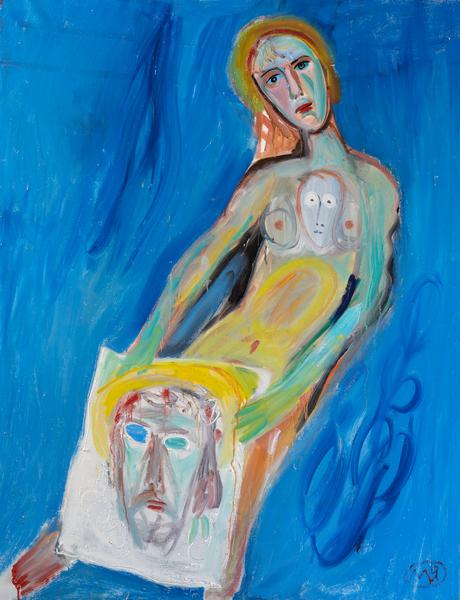
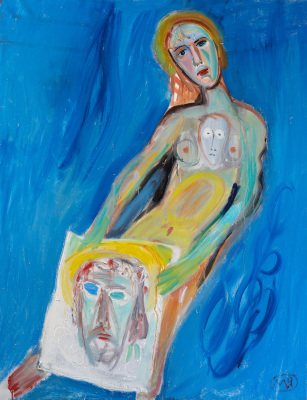
In terms of its formal and symbolic connotations, the work corresponds to the mature period of the artist's oeuvre. Against the background of an intense, almost ultramarine blue colour that fills the entire canvas without any reference to depth or a horizon, emerges the elongated, slightly deformed figure of a nude woman – Saint Veronica. Her face is pale, greenish-ochre, with large, sad eyes and expressive lips, surrounded by a golden-orange aureole that transitions into strands of wavy, reddish-blonde hair. The artist interprets the body not anatomically, but as an almost boneless form: the arms and shoulders flow into one another with broad, soft brushstrokes in shades of turquoise, green and ochre.
The most remarkable element of the composition is a second, smaller face, simply integrated into Veronica's silhouette at the level of the chest and abdomen – pale, almost mask-like, forming a single whole with the plane of her body. It is distinguished by grotesquely schematic white circles of the eyes, in the centre of which dark dots of pupils are placed. This double imagery – a face above a face – can be interpreted as a direct continuation of the theme inherent to the concept of an imprint, a trace, an image that arises not through the act of painting, but through contact, pressure and touch.
Veronica's body becomes yet another "shroud", another surface capable of accommodating someone's face. Below, at the hip level, the figure holds a large white cloth, visually merging with it as if the figure itself grows out of this canvas. The cloth depicts the face of Jesus Christ: a beard, dishevelled hair, traces of blood above the forehead and the frozen gaze of light blue eyes. This part is composed in such a way that the cloth occupies almost a third of the lower half of the painting, dominating the figure of the woman herself. The artist deliberately shifts the focus of the composition from Veronica as a figure to the artefact – the relic she holds.
Iconographically, Myroslav Yahoda's work is based on an established medieval subject which, according to the apocryphal tradition of the sixth Station of the Cross, was imprinted on the cloth with which Veronica wiped the face of Jesus Christ on the way to Golgotha. The classical tradition (from Byzantine and Romanesque Mandylions to interpretations by El Greco and later Symbolists) usually depicts either the face in isolation, somewhat outside the narrative context, or the figure of Veronica with the cloth spread before her. It is this latter, "presentational" scheme that the artist chose. However, Myroslav Yahoda challenges the canonical hierarchy: the relic-cloth almost merges with the woman's body, falling in a heavy, corporeal mass, while the colour of the face on the veil (greenish-pale, with distinct blood stains) echoes the general greenish-ochre hue of Veronica's skin – the boundary between her and the image she holds is blurred.
In the broader context of the artist's oeuvre, with his constant interest in depersonalisation, liminal states and the sacred as a form of liminal experience, "Veil of Veronica" is a reflection not so much on the idea of the Acheiropoieton (an image not made by human hands) as on the very mechanics of reflection. The faces here multiply (the face of Jesus Christ on the cloth, another face on the woman's body, Veronica's own face), creating a chain of trace-images, each subsequent one being a reflection of the previous, so the very idea of a single, coherent personality dissolves in this sequence of touches and mirrorings.
The most remarkable element of the composition is a second, smaller face, simply integrated into Veronica's silhouette at the level of the chest and abdomen – pale, almost mask-like, forming a single whole with the plane of her body. It is distinguished by grotesquely schematic white circles of the eyes, in the centre of which dark dots of pupils are placed. This double imagery – a face above a face – can be interpreted as a direct continuation of the theme inherent to the concept of an imprint, a trace, an image that arises not through the act of painting, but through contact, pressure and touch.
Veronica's body becomes yet another "shroud", another surface capable of accommodating someone's face. Below, at the hip level, the figure holds a large white cloth, visually merging with it as if the figure itself grows out of this canvas. The cloth depicts the face of Jesus Christ: a beard, dishevelled hair, traces of blood above the forehead and the frozen gaze of light blue eyes. This part is composed in such a way that the cloth occupies almost a third of the lower half of the painting, dominating the figure of the woman herself. The artist deliberately shifts the focus of the composition from Veronica as a figure to the artefact – the relic she holds.
Iconographically, Myroslav Yahoda's work is based on an established medieval subject which, according to the apocryphal tradition of the sixth Station of the Cross, was imprinted on the cloth with which Veronica wiped the face of Jesus Christ on the way to Golgotha. The classical tradition (from Byzantine and Romanesque Mandylions to interpretations by El Greco and later Symbolists) usually depicts either the face in isolation, somewhat outside the narrative context, or the figure of Veronica with the cloth spread before her. It is this latter, "presentational" scheme that the artist chose. However, Myroslav Yahoda challenges the canonical hierarchy: the relic-cloth almost merges with the woman's body, falling in a heavy, corporeal mass, while the colour of the face on the veil (greenish-pale, with distinct blood stains) echoes the general greenish-ochre hue of Veronica's skin – the boundary between her and the image she holds is blurred.
In the broader context of the artist's oeuvre, with his constant interest in depersonalisation, liminal states and the sacred as a form of liminal experience, "Veil of Veronica" is a reflection not so much on the idea of the Acheiropoieton (an image not made by human hands) as on the very mechanics of reflection. The faces here multiply (the face of Jesus Christ on the cloth, another face on the woman's body, Veronica's own face), creating a chain of trace-images, each subsequent one being a reflection of the previous, so the very idea of a single, coherent personality dissolves in this sequence of touches and mirrorings.
Legal regulation
Borys Voznytskyi Lviv National Art Gallery