Man and God
Myroslav Yahoda
Basic information
- ID
- Ж-7819
- Author
- Myroslav Yahoda
- Name
- Man and God
- Date of creation
- 1997
- Technique
- oil painting
- Material
- canvas oil
- Dimensions
- 130 x 100 cm (height x width)
Additionally
Information about author
Object description
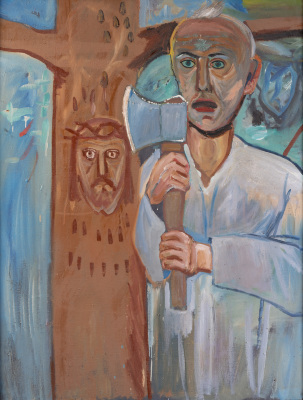
Unlike other works from the same series held in the Gallery's collection – namely "Religious Figures", "Island of Fish" and "Veil of Veronica" – the canvas "Man and God" is dated 1997 (a year earlier than the aforementioned works). It constructs a direct, almost frontal confrontation between two images, rather than combining them into a single whole.
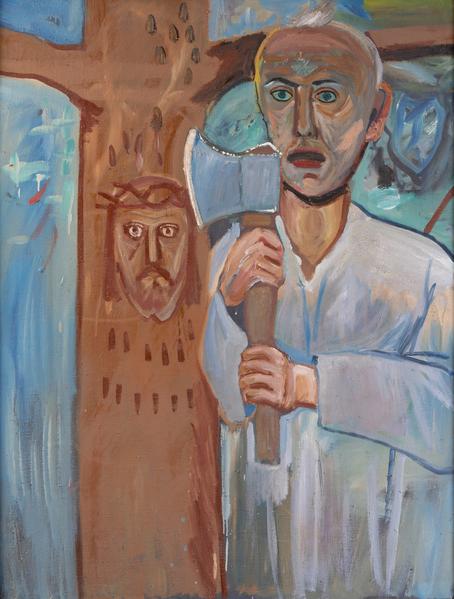
The composition is divided vertically into two unequal parts. On the left stands a brown pillar or column in the shape of a cross, dotted with tiny, dark brushstrokes. These brushstrokes resemble drops or nails falling from top to bottom in two parallel rows. Embedded within the thickness of this column is the face of Jesus Christ in a crown of thorns. It is almost frozen, with wide-open eyes looking directly at the viewer. This is an "Acheiropoieton" countenance, as if captured directly within the structure of the cross, which makes a direct reference to the motif of Veronica's cloth.
On the right, occupying the larger part of the canvas, emerges the figure of a man in a white shirt with an axe in his hand. This is not a heroic image, but a disturbing, almost terrifying one: wide-open green eyes, a mouth open in a speechless scream or numbness. The blade of the axe is raised to the level of the face of Jesus Christ – this gesture can be interpreted in several ways: as a literal action (a woodcutter chopping the cross), as a theological metaphor for sin, or as a broader image of a man armed against his own sacred source. The axe itself, compositionally placed between the human and divine faces, creates a visual axis that simultaneously divides and connects these two poles stated in the work's title.
In terms of colour, the painting is built on the contrast between warm ochre-brown (the image of Jesus Christ and the cross) and cold blue-turquoise colours (the background, the space around the man with the axe). The very distribution of the palette marks the boundary between the two worlds proclaimed in the work's title: the sphere of the divine, embedded within the motionless, archaic matter of wood, and the sphere of man – moving, anxious, armed. The work logically continues the general line of the 1997–1998 series: the sacred here is treated not as a dogma, but rather as an arena of existential drama; not as an object of contemplation, but as a space of direct, intense confrontation between man and his prime source, where the very possibility of violence (the axe) becomes an inseparable part of this relationship.
At the same time, it is worth mentioning a seminal 1885 text by Ivan Franko: "There is no Lord, no Lord in heaven longer!/ There is no sole autocrat, no creator,/ There is no one who with a word almighty/ Brought all from nothing! Like a shadow vast,/ He lay across the whole world, overshadowing/ For hundreds of thousands of years the minds of men./ He squeezed their hearts with iron pincers/ Of anxiety, tore souls, and gulped down blood,/ And the warm steam of slaughtered flesh/ Snuffed in his greedy nostrils! Like a vampire,/ Upon humanity's chest that phantom crouched/ And sucked away its finest vital juices./ And now he's gone! The sun! The sun! The light!/ He is no more! Freedom! I, a worm,/ I, an unnoticeable atom in nature,/ I killed him, ripped him open, cast him to the winds!/ I, with the arrows of thoughts mighty, clear,/ Pierced him right through and felled him/ To the ground, like David did Goliath./ With the sword of knowledge and human experience/ I severed his head. My victory!/ He is no more, and never was!/ I thrust him into that immense nothingness,/ From which there is no return!".
The composition is divided vertically into two unequal parts. On the left stands a brown pillar or column in the shape of a cross, dotted with tiny, dark brushstrokes. These brushstrokes resemble drops or nails falling from top to bottom in two parallel rows. Embedded within the thickness of this column is the face of Jesus Christ in a crown of thorns. It is almost frozen, with wide-open eyes looking directly at the viewer. This is an "Acheiropoieton" countenance, as if captured directly within the structure of the cross, which makes a direct reference to the motif of Veronica's cloth.
On the right, occupying the larger part of the canvas, emerges the figure of a man in a white shirt with an axe in his hand. This is not a heroic image, but a disturbing, almost terrifying one: wide-open green eyes, a mouth open in a speechless scream or numbness. The blade of the axe is raised to the level of the face of Jesus Christ – this gesture can be interpreted in several ways: as a literal action (a woodcutter chopping the cross), as a theological metaphor for sin, or as a broader image of a man armed against his own sacred source. The axe itself, compositionally placed between the human and divine faces, creates a visual axis that simultaneously divides and connects these two poles stated in the work's title.
In terms of colour, the painting is built on the contrast between warm ochre-brown (the image of Jesus Christ and the cross) and cold blue-turquoise colours (the background, the space around the man with the axe). The very distribution of the palette marks the boundary between the two worlds proclaimed in the work's title: the sphere of the divine, embedded within the motionless, archaic matter of wood, and the sphere of man – moving, anxious, armed. The work logically continues the general line of the 1997–1998 series: the sacred here is treated not as a dogma, but rather as an arena of existential drama; not as an object of contemplation, but as a space of direct, intense confrontation between man and his prime source, where the very possibility of violence (the axe) becomes an inseparable part of this relationship.
At the same time, it is worth mentioning a seminal 1885 text by Ivan Franko: "There is no Lord, no Lord in heaven longer!/ There is no sole autocrat, no creator,/ There is no one who with a word almighty/ Brought all from nothing! Like a shadow vast,/ He lay across the whole world, overshadowing/ For hundreds of thousands of years the minds of men./ He squeezed their hearts with iron pincers/ Of anxiety, tore souls, and gulped down blood,/ And the warm steam of slaughtered flesh/ Snuffed in his greedy nostrils! Like a vampire,/ Upon humanity's chest that phantom crouched/ And sucked away its finest vital juices./ And now he's gone! The sun! The sun! The light!/ He is no more! Freedom! I, a worm,/ I, an unnoticeable atom in nature,/ I killed him, ripped him open, cast him to the winds!/ I, with the arrows of thoughts mighty, clear,/ Pierced him right through and felled him/ To the ground, like David did Goliath./ With the sword of knowledge and human experience/ I severed his head. My victory!/ He is no more, and never was!/ I thrust him into that immense nothingness,/ From which there is no return!".
Legal regulation
Borys Voznytskyi Lviv National Art Gallery