Tower of Babel
Myroslav Yahoda
Basic information
- ID
- Ж-7820
- Author
- Myroslav Yahoda
- Name
- Tower of Babel
- Date of creation
- 1997
- Technique
- oil painting
- Material
- canvas oil
- Dimensions
- 130 x 100 cm (height x width)
Additionally
Information about author
Object description
"Tower of Babel" is dated 1997 – just like the canvas "Man and God". Together, they belong to the same cycle as "Religious Figures", "Island of Fish" and "Veil of Veronica" (1998), revealing the mature period of the artist's oeuvre, dedicated to sacred themes reinterpreted through the prism of a personal, almost intimate experience of a liminal state.
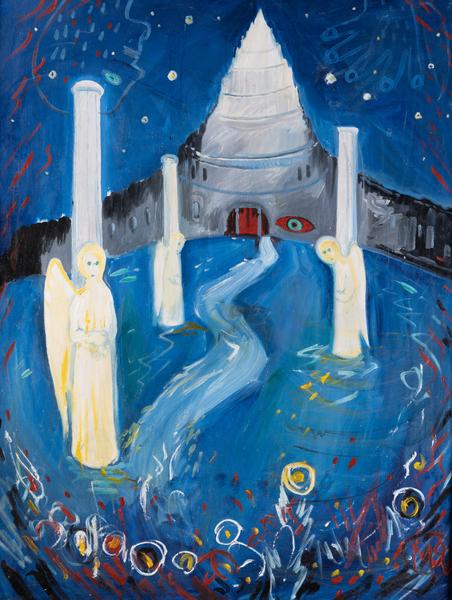
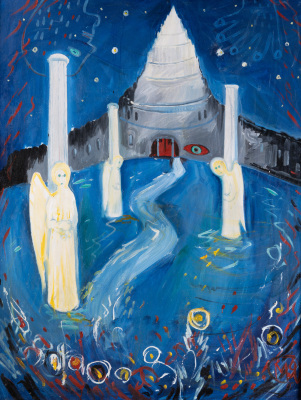
Compositionally, the canvas is constructed according to the logic of a gaze from an unknown eminence. The deep, rich cobalt-blue space is interspersed with flashes of red and white brushstrokes resembling falling meteorites, comets or a specific starry sky. Bereft of any astronomical specificity, this visual space conveys a state of cosmic anxiety rather than a classical landscape.
In the upper part, which dominates the entire composition, towers the structure itself – a multi-tiered greyish-white spiral that narrows at the top to a sharp spire, resembling stairs or a snail shell coiled around its axis. At the bottom, the building transitions into a massive circular base with dark window openings and a small doorway, the colour of which is marked by an intense dark red pigment that sharply contrasts with the cold tones of the rest of the canvas. Slightly above the entrance is a striking surrealist detail – a large image of an eye (an allusion to the iconographic concept of the "All-Seeing Eye" or Eye of Providence), embedded into the wall of the building at a level where a window would normally be located. Such a motif can be interpreted as a sign of divine surveillance over human architectural ambitions. The eye, observing man's attempt to reach the heavens, hints at the finale of the biblical story from the Book of Genesis about the confusion of tongues and the scattering of peoples as a punishment for pride.
In front of the tower, in the lower half of the canvas (on both sides and in the centre of the composition), three white angelic figures are placed like columns or pillars. These vertical, elongated figures in white and yellow robes are depicted with their hands lowered or folded in prayer, and with frozen faces devoid of distinct emotions. Their static, column-like regularity contrasts with the dynamics of the rippling flow running between them – a light blue, almost phosphorescent river or stream. It meanders from the foot of the tower to the foreground of the painting, dividing the composition down the centre while simultaneously connecting the heavenly with the earthly.
In this same lower register, the space is saturated with small decorative elements: concentric circles and rings of yellow, white and dark colours, resembling eyes, bubbles or cosmic bodies scattered on a dark blue background alongside reddish brushstrokes of grass or flame. It is worth emphasising that the lower strip is the most abstract part of the painting. It does not lend itself to an unambiguous formal reading, but rather creates the impression of a magma-like, vibrant space of the earth from which the tower rises.
Iconographically, the artist draws upon the classical subject of the Tower of Babel (Genesis 11:1–9) but significantly transforms it. Traditional European compositions – from the miniatures of medieval manuscripts to the philosophical interpretations of Pieter Bruegel the Elder – usually depict the tower as a massive, semi-ruined or unfinished structure surrounded by the clamour of builders, emphasising collective human labour and its futility. Myroslav Yahoda, on the contrary, completely obliterates the presence of people in terms of active construction: there are no workers, scaffoldings or the chaos of incomprehensible tongues. Instead, the building emerges as a completed, serene, almost dreamlike and spectral structure watched over by the Sleepless Eye and surrounded by silent angelic guardians. Such a shift in emphasis – from the drama of construction to its aftermath, the silence after (or perhaps before) the catastrophe – is characteristic of the artist's general logic. The artist views the sacred narrative not as a chronological history, but as a frozen, timeless image of a liminal state.
In the context of the entire 1997–1998 series, "Tower of Babel" continues the line established in the canvas "Man and God", namely – the theme of distance and tension between human ambitions and the divine order. However, it shifts this theme to the register not of direct confrontation (such as the axe raised to the face of Jesus Christ), but of a silent, nocturnal waiting, where the very architecture of sin is already realised and forever frozen under the gaze of an eye that never closes.
Compositionally, the canvas is constructed according to the logic of a gaze from an unknown eminence. The deep, rich cobalt-blue space is interspersed with flashes of red and white brushstrokes resembling falling meteorites, comets or a specific starry sky. Bereft of any astronomical specificity, this visual space conveys a state of cosmic anxiety rather than a classical landscape.
In the upper part, which dominates the entire composition, towers the structure itself – a multi-tiered greyish-white spiral that narrows at the top to a sharp spire, resembling stairs or a snail shell coiled around its axis. At the bottom, the building transitions into a massive circular base with dark window openings and a small doorway, the colour of which is marked by an intense dark red pigment that sharply contrasts with the cold tones of the rest of the canvas. Slightly above the entrance is a striking surrealist detail – a large image of an eye (an allusion to the iconographic concept of the "All-Seeing Eye" or Eye of Providence), embedded into the wall of the building at a level where a window would normally be located. Such a motif can be interpreted as a sign of divine surveillance over human architectural ambitions. The eye, observing man's attempt to reach the heavens, hints at the finale of the biblical story from the Book of Genesis about the confusion of tongues and the scattering of peoples as a punishment for pride.
In front of the tower, in the lower half of the canvas (on both sides and in the centre of the composition), three white angelic figures are placed like columns or pillars. These vertical, elongated figures in white and yellow robes are depicted with their hands lowered or folded in prayer, and with frozen faces devoid of distinct emotions. Their static, column-like regularity contrasts with the dynamics of the rippling flow running between them – a light blue, almost phosphorescent river or stream. It meanders from the foot of the tower to the foreground of the painting, dividing the composition down the centre while simultaneously connecting the heavenly with the earthly.
In this same lower register, the space is saturated with small decorative elements: concentric circles and rings of yellow, white and dark colours, resembling eyes, bubbles or cosmic bodies scattered on a dark blue background alongside reddish brushstrokes of grass or flame. It is worth emphasising that the lower strip is the most abstract part of the painting. It does not lend itself to an unambiguous formal reading, but rather creates the impression of a magma-like, vibrant space of the earth from which the tower rises.
Iconographically, the artist draws upon the classical subject of the Tower of Babel (Genesis 11:1–9) but significantly transforms it. Traditional European compositions – from the miniatures of medieval manuscripts to the philosophical interpretations of Pieter Bruegel the Elder – usually depict the tower as a massive, semi-ruined or unfinished structure surrounded by the clamour of builders, emphasising collective human labour and its futility. Myroslav Yahoda, on the contrary, completely obliterates the presence of people in terms of active construction: there are no workers, scaffoldings or the chaos of incomprehensible tongues. Instead, the building emerges as a completed, serene, almost dreamlike and spectral structure watched over by the Sleepless Eye and surrounded by silent angelic guardians. Such a shift in emphasis – from the drama of construction to its aftermath, the silence after (or perhaps before) the catastrophe – is characteristic of the artist's general logic. The artist views the sacred narrative not as a chronological history, but as a frozen, timeless image of a liminal state.
In the context of the entire 1997–1998 series, "Tower of Babel" continues the line established in the canvas "Man and God", namely – the theme of distance and tension between human ambitions and the divine order. However, it shifts this theme to the register not of direct confrontation (such as the axe raised to the face of Jesus Christ), but of a silent, nocturnal waiting, where the very architecture of sin is already realised and forever frozen under the gaze of an eye that never closes.
Legal regulation
Borys Voznytskyi Lviv National Art Gallery